If hidden cameras were set up in the homes of a thousand people to figure out how to quit vaping for good, we would see the exact same scene play out on Sunday night even if a lot of us live totally different lives.
Sometimes you look at the device and you feel the guilt in your chest: that heavy, tight feeling that says, “I don’t want to be controlled by this anymore.”
Now you aren’t just worried about the health risks; you are dreading the onset of nicotine withdrawal symptoms that usually hit early on Monday morning. Yet you march to the kitchen, throw the vape deep into the trash, and say to yourself or even out loud, “This time is different.” And you mean it; you truly do, but Tuesday afternoon comes, work is stressful and you’ve been battling insomnia. Then your brain starts the negotiation: “Just one hit to get through this email,” it whispers and suddenly, the quit vaping timeline you set for yourself resets back to ground zero and now you find yourself digging through the trash or even driving to the shop to get your lost companion right back. It’s done!
Then comes the shame and guilt. You start to think, “I’m weak and I have no self-control.” Here is the truth that nobody tells you: You are not weak. You are fighting a chemical war with a biological battery.
There is something called the Myth of the “Iron Will” and psychologists have discovered that willpower is a finite resource. Think of it like a battery on your phone. Every time you make a decision during the day on what to wear, how to reply to that annoying email, what to eat for lunch; you drain that battery.
By 4:00 PM, your “willpower battery” is in the red zone and that is exactly when the nicotine craving strikes. You aren’t failing because you lack character; you are failing time and again because you are trying to fight a heavyweight boxer (addiction) when you are already exhausted.
However, there is the science that changes everything: A craving is not a permanent state. It is just a wave.
Research shows that an intense craving typically lasts only 3 to 5 minutes. So if you can “surf” that wave, if you can interrupt the pattern for just those few minutes you’ll find that the chemical urgency dies down, and your brain moves on like it never happened.
The problem is, during those 3 minutes, your brain starts to lie to you. It tells you the feeling will last forever unless you vape.
Strength is not enough; you need interruption!
The people who successfully quit (yes they exist and you can be one of them too) aren’t the ones who white-knuckle it. They are the ones who have a strategy for the 3-Minute Wave. They use valuable tools like “Pattern Interrupts” such as
*Drinking a glass of ice-cold water to shock their system,
* Changing the room they are sitting in, or
* Talking to someone.
The bottom line is “just move”, be in motion. This is the missing link. When you are alone with your thoughts, the addiction usually wins the debate. But when you externalize it, when you tell someone, “I am struggling right now” you will find that the power of the craving shrinks to a minimal dot.
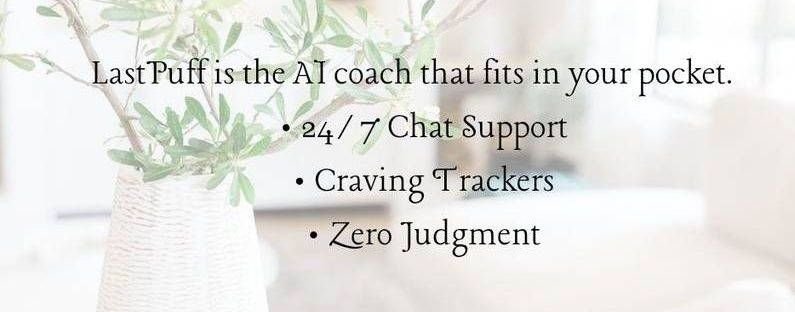
All of this is why we built the LastPuff AI Coach. We have realized that your best friend might not answer the phone at 2:00 in the morning, and your partner might not understand the irrational anger of withdrawal.
What you need is a voice during that 3-minute window. You need a tool that doesn’t judge you, doesn’t lecture you, but simply helps you ride the wave until it breaks.
Stop trying to be a hero on Sunday night. Start building a strategy for Tuesday afternoon. You don’t have to do this alone anymore.
Anticipate https://Www.lastpuff.ai and get started on your journey your freedom.
Sources:
1. American Psychological Association. (n.d.). Willpower: The limited resource. https://www.apa.org/topics/personality/willpower-limited-resource
2. Mayo Clinic. (2022, May 24). Quitting smoking: 10 ways to resist tobacco cravings. https://www.mayoclinic.org/healthy-lifestyle/quit-smoking/in-depth/nicotine-craving/art-20045454
3. National Institute on Drug Abuse. (2020, June). Behavioral therapies for drug addiction. https://nida.nih.gov/publications/drugfacts/treatment-approaches-drug-addiction
4. UCSF Health. (n.d.). Managing cravings and triggers. University of California San Francisco. https://www.ucsfhealth.org/education/managing-cravings